A case study is the most persuasive asset a B2B marketing team can produce and one of the most painful to write. The raw material almost always exists: an interview, a win story, a set of notes, a call recording. But it dies there, in a format nobody can search or reuse, and turning it into a credible, quantified narrative means a slow slog through scattered inputs, with one ever-present risk: inventing a metric that a prospect can immediately call out.
Generic AI makes that risk worse, not better. Ask a blank-prompt chatbot to "write a case study" and it will happily produce confident, specific numbers it has no basis for. For an asset whose entire value is credibility with a skeptical buying committee, a fabricated stat is not a small error. It is a disqualifier.
We think a case study should be directed, not prompted, and grounded so tightly that every number is traceable. Here is how.
The real problem: proof trapped in the wrong format
The case study problem is really two problems wearing one coat.
The first is the file-format trap. The win story exists, but it is locked in an incompatible format: a recorded call, a rep's email, a customer's offhand comment in a QBR. None of it is in a shape the marketing team can build on, so the case study that should take an afternoon takes three weeks of chasing.
The second is credibility under pressure. A buying committee reads a case study looking for reasons to disbelieve it. Vague outcomes ("improved efficiency"), missing context ("a leading enterprise"), and above all numbers that do not add up will sink it. The asset has to be specific and quantified, and every specific has to be real.
Our take: direct an engine over content you own, and never invent
Do not ask a chatbot to write a case study from a blank prompt. Direct an engine over the win story you already own, so the output is grounded in real source material and every claim is traceable back to it.
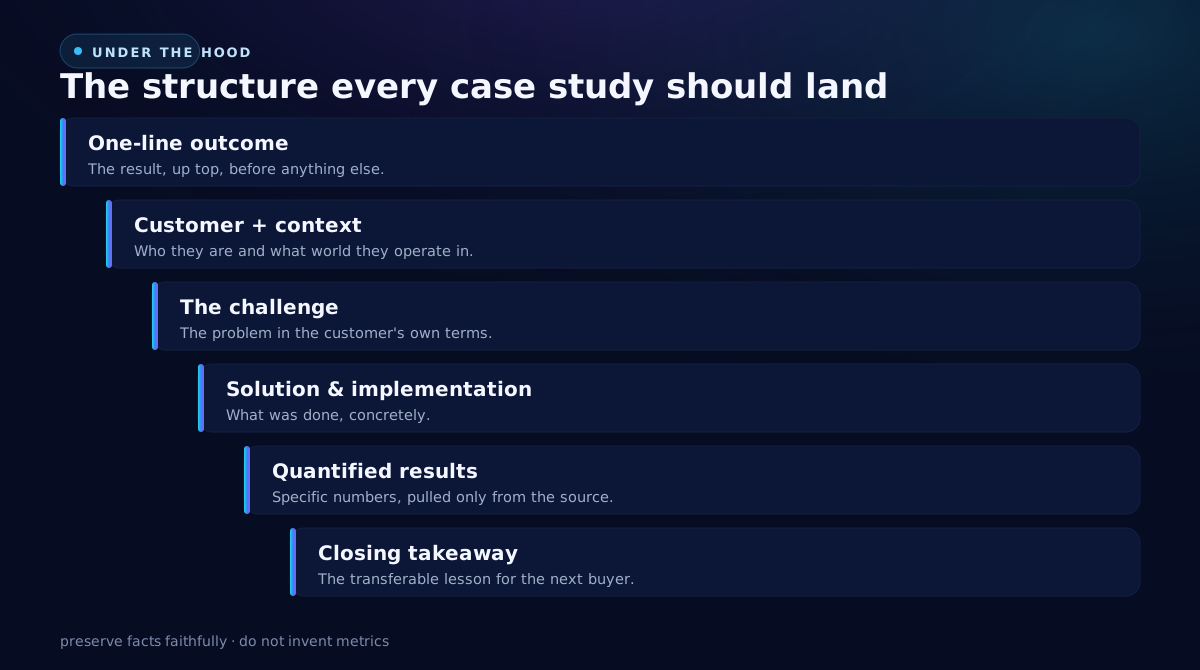
Bring the win story into your Gallery, the interview transcript, the notes, the call recording (it is transcribed), and ask the Studio for a case study with a buyer-ready structure. Its Write a document capability follows the structure you give it, section by section:
- A one-line outcome up top, the result before anything else.
- The customer and context: who they are, what world they operate in.
- The challenge, in the customer's own terms.
- The solution and implementation, concretely.
- Quantified results, with specific numbers pulled only from the source.
- A short closing takeaway, the transferable lesson for the next buyer.
Ask for a credible, specific, results-focused tone, aimed squarely at a B2B buying committee, and hold it to the rule that matters: preserve facts from the source faithfully, and do not invent metrics.
Grounded, not invented, is a product principle, not a nicety. If the number is not in your source, it does not appear in your case study.
Why provenance is the credibility feature
Two mechanics make "do not invent metrics" more than a hope.
First, before you write a word, ask the Studio to Extract facts from the source: every claim, every figure (with its unit and what it measures) and every quote (with who said it) is filed as its own item, linked to the exact sentence it came from. Only what the source states is kept. That list is the case study's evidence, and you can check it against the recording before anything is drafted.
Second, the document is written from that source and cites its claims to it, so a number in the case study can be traced back to where it was said.
This is the opposite of a chatbot's confident fabrication. The case study is not a fresh generation loosely inspired by your notes. It is a faithful transformation of them, with the receipts attached.
The output is an editable report page that downloads as a PDF, or as Word and PowerPoint, for whatever the moment calls for. And because it is filed with the rest of your material, the same case study can be remade into a carousel of the key results, a one-pager, or a deck, all drawn from the same grounded source.
One skill, many written assets
The case study is one of a family of written assets that come from the same place and differ only by the structure and tone you ask for: press releases, byline articles, website copy, sales playbooks, messaging frameworks, and campaign briefs. The common thread is the same discipline you want in a case study specifically: a clear structure, a grounded source, and no invented facts.
Write the case study from the story you already have. Keep every number traceable. That is proof a buying committee can trust, because it is proof you can actually stand behind.
Related: turn research into a designed white paper, and write an SEO blog post with a real point of view.