Most B2B campaigns begin as a verbal goal and a Slack thread. The owner, the KPIs, the asset list, and the timeline are never pinned in one operational document, so two weeks in nobody quite agrees on what success looks like or who owns what. And the budget math, the part that decides whether the whole thing is worth doing, lives in a fragile spreadsheet that a different person built and only they understand.
These are the two halves of planning a campaign: the brief, which says what you are doing and who owns it, and the media plan, which says what your spend actually buys. Both are usually done badly, and both can be done well without inventing numbers or babysitting a spreadsheet.
Here is how we think about the operational half of Plan.
The real problem: plans that are neither pinned nor honest
A campaign brief fails in one of two ways. Either it never gets written, and the campaign runs on tribal memory, or it gets written by an AI that confidently fills every field, including the ones nobody actually knows yet, so it reads as authoritative while being partly fiction.
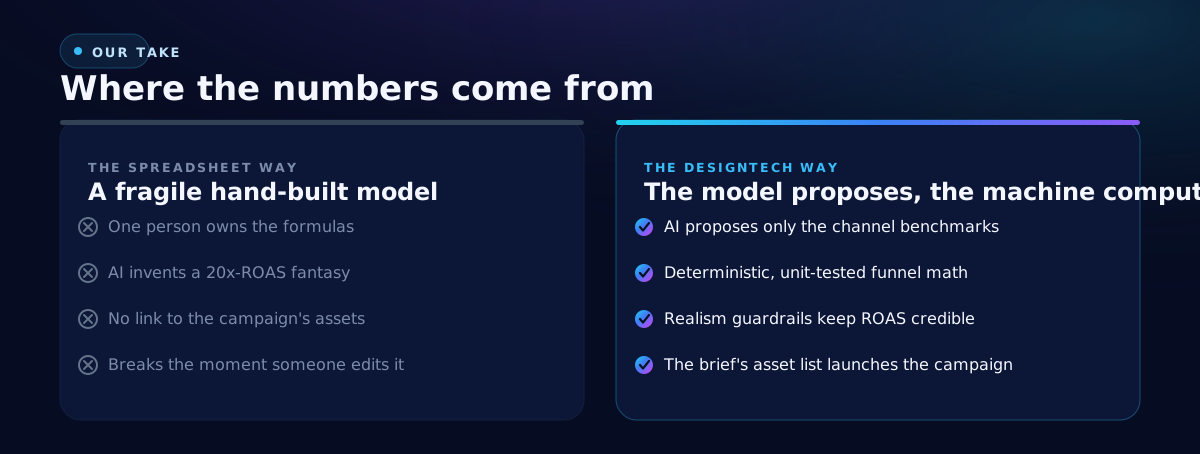
The media plan fails differently. A hand-built model is only as trustworthy as the person maintaining it, and an AI asked to "build me a media plan" will cheerfully hand you a 20x-ROAS fantasy, because it is optimizing for a plausible-looking table, not for arithmetic you could defend to a CFO.
Both failures come from the same root: letting the model decide things it should not, and not pinning the things it should.
Our take: honesty over invention, and let the machine do the math
Two principles, one for each artifact.
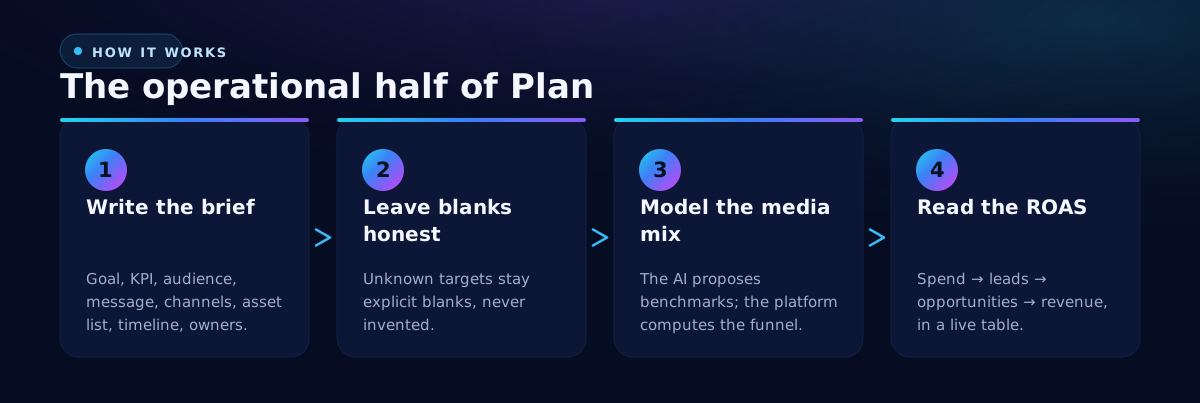
The brief leaves unknowns as explicit blanks. Ask the Studio for a campaign brief and give it the structure: goal and KPI, audience, key message, channels, asset list, timeline, and owners. Its Write a document capability composes it from the source you point it at, and you hold it to one rule: pull KPIs and targets only from the source, and leave unknowns as explicit blanks rather than inventing them. The Studio's Plan a campaign backwards capability starts from the conversion you want and works back through each stage to the first touch, so the asset list follows from the goal rather than from habit. A brief that honestly says "target CPL: TBD" is far more useful than one that fabricates a number everyone then treats as real.
The media plan lets the model propose and the platform compute. This is the important design decision. The Studio's Media plan capability takes your budget and average deal value, and any figures you already have: a channel's cost, its click-through, its qualify rate. The AI proposes only what is missing, as typical benchmarks for each channel (budget share, cost basis, click-through, click-to-lead, qualify rate, win rate). Then the platform computes the funnel deterministically, with pure, tested arithmetic: spend to impressions to clicks to leads to opportunities to sales to revenue, plus cost per lead, cost per sale and ROAS.
The model never decides the arithmetic, only the assumptions. Trust comes from the machine doing the math.
Every assumption says whose it is
Because the model only proposes benchmarks, the plan can say exactly which numbers are yours and which are not. Every assumption in the table is marked either as a figure you gave or as a benchmark, and the plan warns you, in words, where benchmarks rather than your own figures drive a channel, so you replace them before committing budget. It also refuses what cannot be computed: budget shares that do not add up to 100%, a rate outside 0 to 100%, a channel with no price. And it says when a channel is modelled at less than one sale a period, or when the whole budget buys too few leads to check the plan against results quickly.
The result is a twelve-column allocation table (share, spend, impressions, clicks, leads, cost per lead, opportunities, sales, cost per sale, revenue and ROAS, per channel and in total), filed as an editable document, with the assumptions beneath it laid out to be argued with.
One honest boundary worth stating plainly: this is an assumption-driven funnel forecast, not measured attribution. It tells you what a media mix should produce given realistic benchmarks. Checking it against what actually happened is the job of analyzing your results.
Where a campaign is born
The brief is not just documentation. Its asset list is what you produce next, from the same sources, and every asset made from them stays traceable back to the source it was built from. So the plan you pin here is what the production work fans out from, and what your results are measured against.
Pin the plan before the pixels. Keep the brief honest about what you do not yet know. And put a deterministic engine under the numbers, so the model proposes and the machine computes. That is a campaign plan you can defend.
Related: distill the message the campaign will carry, and close the loop by analyzing what the campaign actually did.