Ask five people at a B2B company to describe what the product does and you will get five different answers. Ask to see the messaging and you will be pointed at ten decks, each with a slightly different version, none of them canonical. Product marketing says it one way, sales another, demand-gen a third. There is no single source of truth, so every asset re-litigates the positioning from scratch, and the message drifts a little further with each rewrite.
A messaging framework is supposed to be the fix. In most orgs it is a static document that was accurate the day it was approved and out of date the day after, because nothing downstream is actually bound to it. It sits in a drive while the real messaging evolves, uncontrolled, across a thousand assets.
We think a messaging framework should be a living block that every asset inherits from, not a PDF that drifts. Here is how to build one.
The real problem: positioning without a spine
The core issue is not that teams lack messaging. It is that they lack one authoritative version of it, in a form other work can actually reference.
When the framework is a file, "inheriting" from it means a human remembers to open it and copy the right sentence. That never scales. So the value pillars mutate, the boilerplate exists in four incompatible lengths, and the proof points get quietly dropped whenever someone is in a hurry. The message is not wrong anywhere in particular. It is inconsistent everywhere in general, which is worse, because inconsistency is what erodes trust with a buying committee that sees your content across a dozen touchpoints.
Our take: distill one source of truth, grounded in what you own
A messaging framework is the canonical Message in the way we think about marketing: Audience times Message times Channel. It is the medium-neutral spine every downstream asset should inherit, the reusable unit of meaning that a blog post, a sell sheet, and an ad are all just channel expressions of.
So the opinion is direct: distill one source of truth, ground every claim in what you actually own, and make it a live block others build from.
A messaging framework is the Message every downstream asset should inherit from, not a static file that drifts the day it ships.
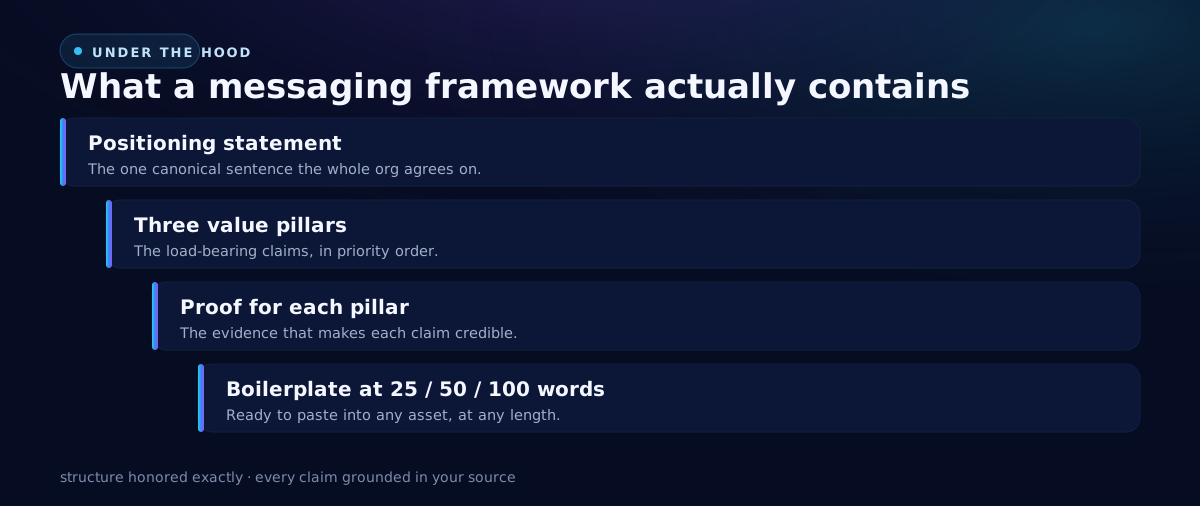
In DesignTech AI you ask the Studio for a messaging framework and point it at your positioning notes, product information, research or existing messaging. Its Write a document capability composes that source into a canonical, sectioned document, and you give it the structure:
- A positioning statement: the one sentence the whole org can agree on.
- Three value pillars: the load-bearing claims, in priority order.
- Proof for each pillar: the evidence that makes each claim credible, not just asserted.
- Boilerplate at 25, 50, and 100 words: ready to paste into any asset, at any length, without a rewrite.
Ask for a crisp, canonical tone, name the audience (your ideal customer profile and buying committee), and hold it to one source of truth with consistent terms throughout, every claim grounded in the source.
How it stays honest and consistent
Two mechanics do the quiet work.
First, the structure you supply is treated as authoritative. Each named section becomes a heading, in order, and the document does not revert to the source's own shape. You get the positioning, pillars, proof and boilerplate you asked for, not whatever structure the input happened to have.
Second, it writes from one source at a time, the one you point it at, and grounds every claim in that. If your positioning is spread across a deck, a research briefing and a page of notes, bring them in first (or ask the Studio to research the market), then point it at the one that holds the argument, and give it the others as evidence it must obey. Nothing is fine-tuned on your data; the grounding is the text you gave it.
The output is filed in your Gallery, linked to its source, editable, and available to ground everything you make next.
Why this belongs in Plan
Positioning is a Plan-stage decision, and getting it into a canonical, machine-referenceable form is what makes the rest of the workflow coherent. When your blog posts, sales collateral, and carousels are all grounded in the same framework, consistency stops being a thing you police on every asset and becomes a property of the system.
Build the spine once. Let everything inherit it. That is how a message stays canonical across a thousand assets instead of drifting across ten decks.
Related: research the market that your positioning has to win in, and turn the framework into a campaign brief with real KPIs.