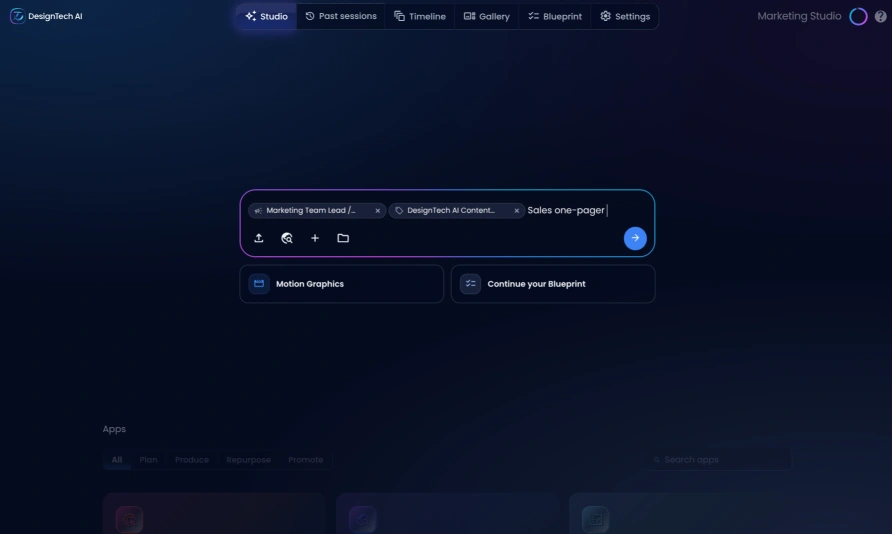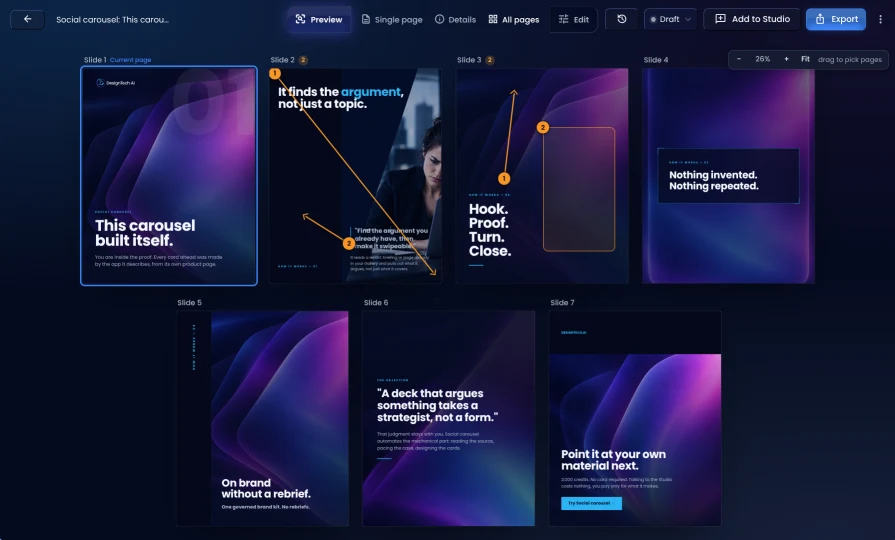
Everyone got faster this year. Almost nobody got better. DesignTech AI learns your audience, your voice, and what good looks like from the work you've already made, then turns your webinars, reports, and decks into assets only your team could have made.
Built for B2B demand-gen teams. Trained on your best work, not the internet's average. Ship it in-house, without the agency retainer.
auto_awesomeAll of this came from one webinar
Two minutes, end to end: define the buyer, feed it a webinar, run the Job, and judge what comes back.
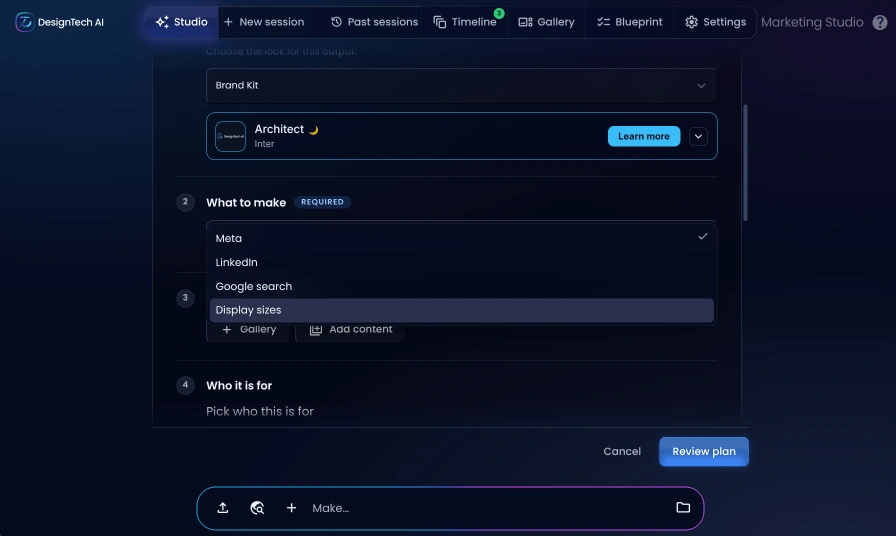
Audience, message, channel, with your brand as the layer over all of it.
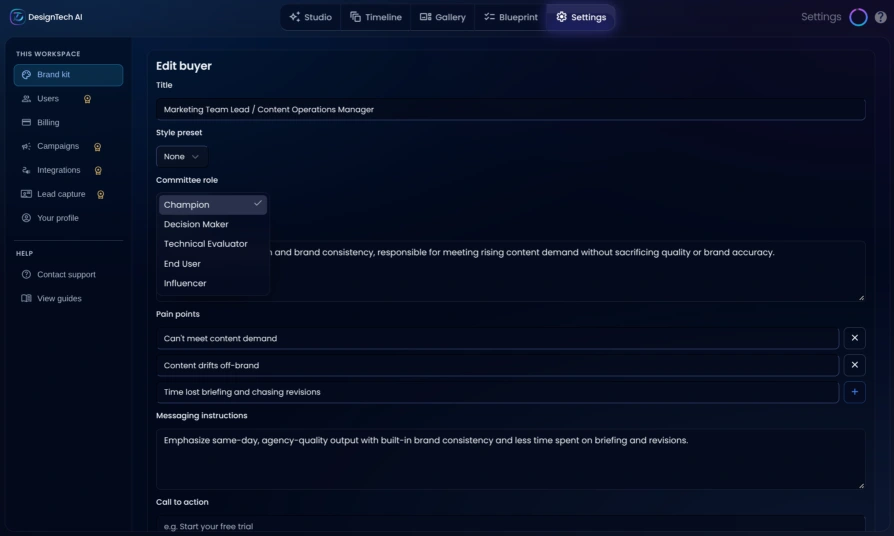
Marketing starts with who it's for. Give it your ICP, your buyer personas, and the problem you solve. Every asset is aimed before it's made.
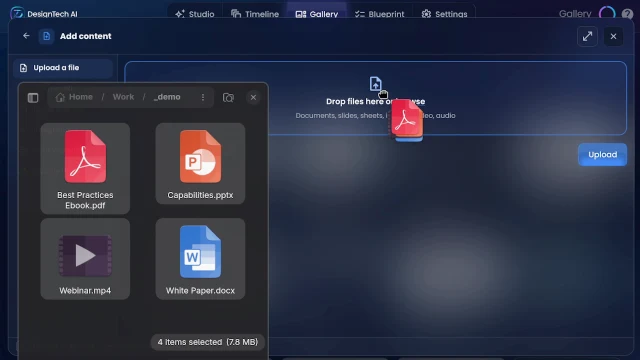
groupFeed the ContentCanvas your webinars, reports, decks, and posts, or sync Drive and LinkedIn. Everything becomes reusable material: the right thing to say to those buyers.
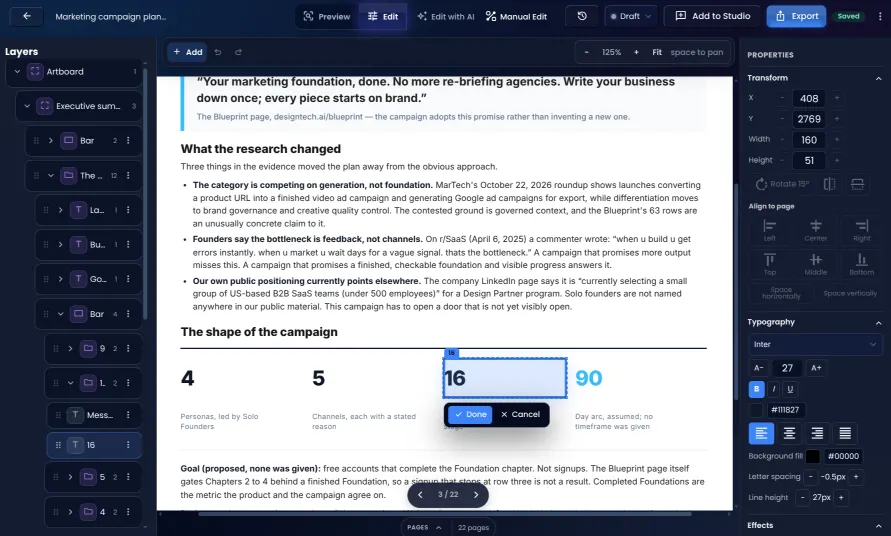
forumRun the catalyst and get back the full set: carousels, emails, video, pages, ads. Each one built to your standard, formatted for where your buyers already are. Nothing ships without sign-off.
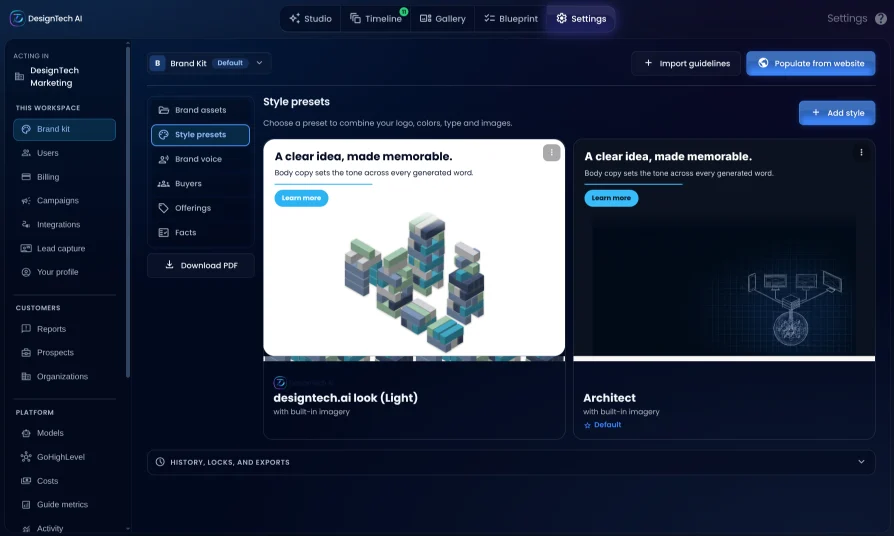
hubShow it a carousel you're proud of and it learns both halves of how you work: the look, and the rules you follow without thinking. Then every step of every run is routed to the model best at it. Strategy, design, motion, voice. Each format is made by a specialist, held to your standard.
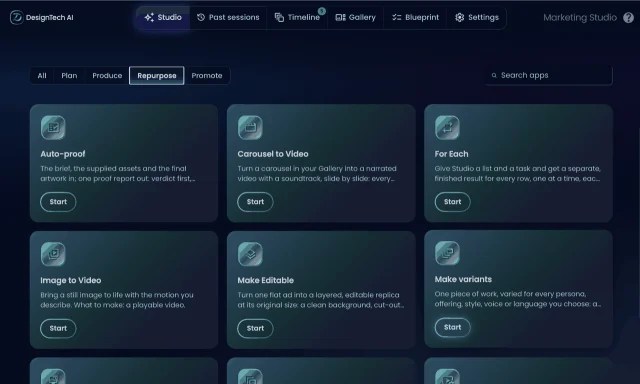
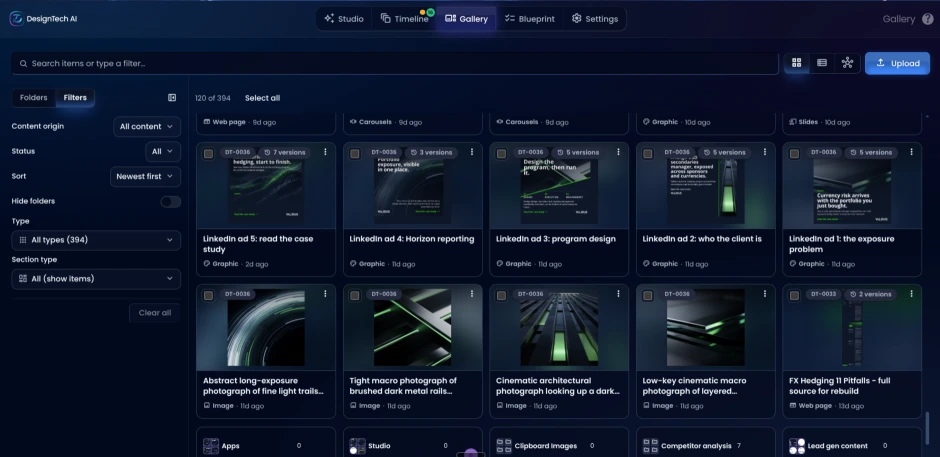
Every format your channels need, each made by a specialist rather than one generalist, and every one of them built to the standard you taught it.
A file is finished the day it ships. An intelligent asset is not. Every asset knows the source it came from, keeps every version it has ever been, and carries its own performance. Correct a number in the source report and every asset built on it offers to refresh itself. Edit once, and it updates everywhere.
videocamRecording slot: real version history + refresh, ~10s loop. Set data-living-src to replace this mock.
Forrester calls this intelligent content: self-optimizing, goal-oriented artifacts that fuse human creativity, AI, and data. It is the category this platform was built for.
The honest comparison, including where the other two win. Most teams should keep all three.
None of this is a fight. DesignTech AI ships an MCP server, so the agents your team already uses can call it: your content, your brand, and your approval gate, from wherever you work.
Pick an assistant. It opens in a new tab with the question already written, and we ask it to be skeptical and to say where it beats us. Read the answer before you read another word of ours.
We copy the prompt to your clipboard on the way out, because Claude sometimes opens with an empty box. If that happens, paste it.
Answered the way we would answer them in the room, including the parts where the answer is not yet what we want it to be.
helpWhy you, and not the obvious alternative
The models are Claude and Gemini, and we say so out loud. What you are buying is not the model, it is everything built around it: your content ingested into one graph, your brand applied when the asset renders, a source recorded on every claim, org-level roles and approvals, and named jobs you can re-run and hand to a new hire.
Swap the model underneath and all of that still stands. A chat window cannot give you any of it, and unlike a chat window it compounds. The graph is worth more in month twelve than it was in month one, because by then it holds your content, your voice, and your judgment about what good looks like.
Turning content you already own into the full set of assets a campaign needs. One webinar becomes the carousel, the posts, the ads, the landing page, the nurture email, and the short video, in your brand, aimed at your buyer.
If your problem is a blank page, a copilot is cheaper and you should use one. If your problem is a back catalog that got used once and then sat there, that is the job we built for.
Nothing stops them trying, and we are not going to pretend otherwise. What slows them is that each of them is anchored to its own silo and its own legacy interface, and unifying content across every tool a marketing team uses works against that.
The part that is actually defensible is not our software, it is your graph: your content, your brand, and your accumulated judgment, at a depth nobody can re-derive by scraping your website. That takes time to build and it belongs to you, not to us.
Honestly, on day one we add reach more than we remove tools, and a claim otherwise would not survive month two. What consolidates is the work: one place your content lives, one place assets get made, one brand layer over all of it, instead of a design queue, a writing subscription, and a folder nobody can search.
Teams usually drop the freelance design spend and the second AI writing seat first.
rate_reviewOutput quality and brand safety
We are not going to quote you a percentage we have not measured across your team and your category. Any vendor who does is guessing at you.
What we will say: it is taught from work you are already proud of rather than the internet's average, editing is block level so fixing one line does not mean regenerating the whole asset, and the trial runs on your own content. Produce three assets and count it yourself. That number is worth more than ours.
Three things, and one gap we will name. Every generated block records which approved source it came from, enforced when it is written rather than added afterward, so any claim traces back to something you actually published. Invented source references are dropped rather than kept. And nothing leaves your workspace without a person approving it.
The gap: we do not yet hard block a banned phrase or an unsourced claim before a human sees it. Review is a human step today. We would rather tell you that now than have you find it in week three.
Yes. Assets sit in review with their full version history and the source they were built from, roles control who can publish, and outbound actions are gated on approval. It publishes to accounts you connect, on your schedule, after someone says yes. It never posts on its own.
It learns from what you give it: your Brand Kit, your personas, and the specific assets you point at as good. The more of your real work it has seen, the closer it lands, which is why the first afternoon matters more than the first prompt.
To be precise about a word other vendors are loose with: we do not fine-tune a model on your data. We steer a frontier model with your material at run time, which means everything it learned about you stays visible, editable, and deletable by you.
folder_openOur content, and getting started
Well, and we test it hard because everything downstream depends on it. Fifteen format parsers cover text, markdown, HTML, PDF, DOCX, images, video, and audio, with vision models reading charts, tables, and slides.
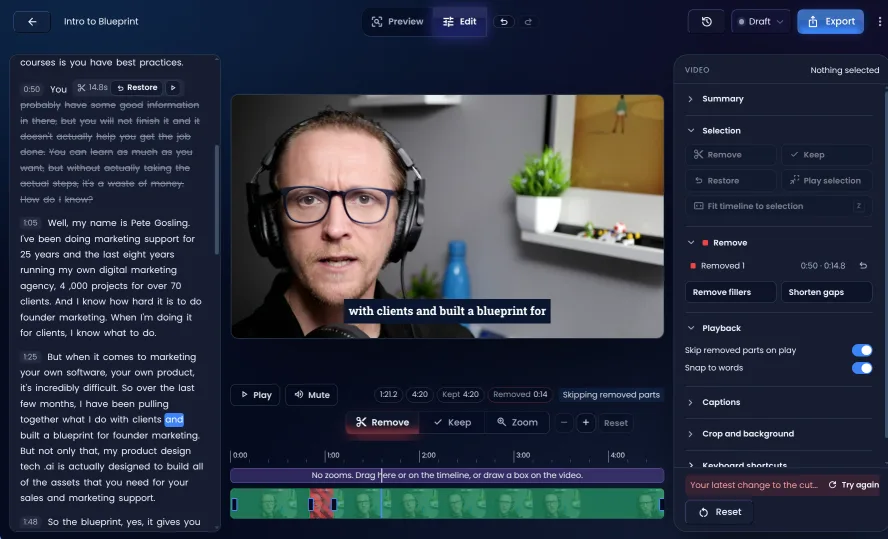
A tabular white paper comes in clean. So does an hour-long webinar recording, down to the minute a point was made, which is what makes an asset traceable back to it later.
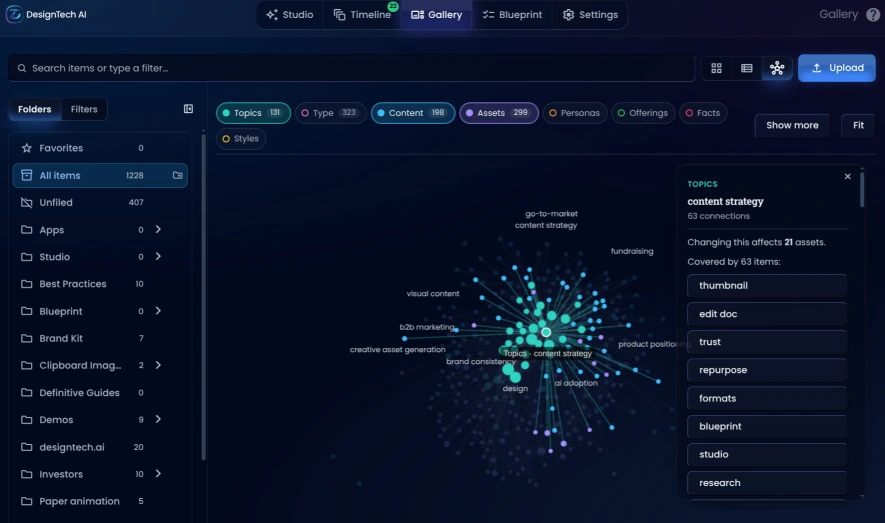
Three things. Search across all of it in one place, including inside videos and decks, so nobody rebuilds a slide that already exists. Use any of it as grounded material, so new work is built from what you have already said rather than invented. And repurpose it: pick a source, pick the channels, and get the set back.
Connect a source and run a job the same day. That part is genuinely fast.
The honest part: output gets meaningfully better once it has seen a real slice of your back catalog and your Brand Kit is filled in properly. That is an afternoon of someone's attention, not a quarter of implementation, and it is the highest return hour you will spend on the platform.
The surfaces your team lives in are fixed: ContentCanvas where your content sits, the job gallery, the calendar, the review queue. Those do not move.
What assembles per task is the inside of a run, so a job asks the questions that job actually needs instead of showing a marketer forty fields that do not apply. Jobs are named and repeatable, which means training a new hire is showing them a job and watching them run it, not teaching them prompt craft.
The fair version of this question is: does it become shelfware. The answer we would give you is to buy it for a loop you already run every week, not for an experiment. A weekly LinkedIn cadence, a quarterly report to repurpose, a campaign that needs eight formats.
Jobs are named and repeatable rather than improvised, so the same run works the same way next month with a different source, and a new hire can run it without learning prompt craft.
hubOur stack, and publishing
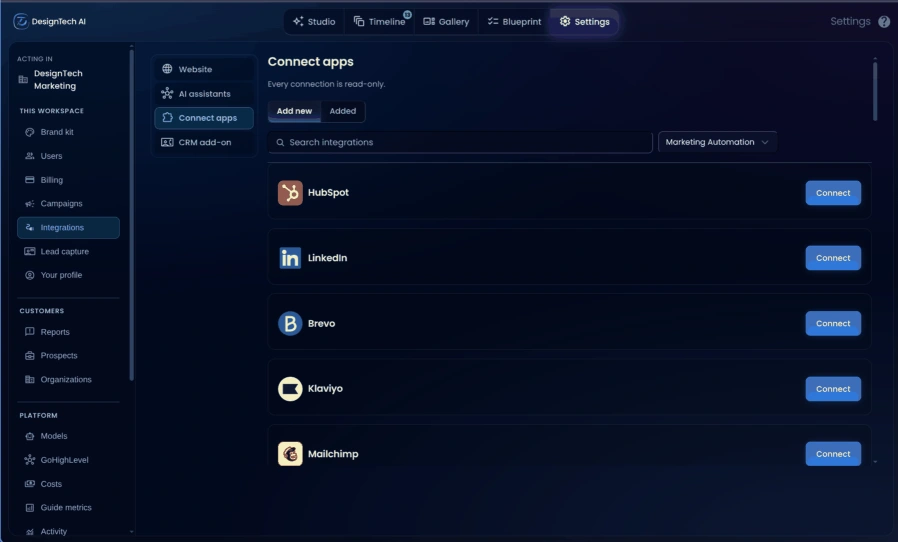
Both, and we will tell you which is which about your specific tools rather than showing you a logo wall. Connections run through a managed OAuth gateway that reaches a large app catalog, and LinkedIn is the one we have built deep, organic and paid, because that is where B2B attention actually is.
Name your stack on the call. We will say plainly whether it is connected today or whether it is export and upload for now.
No, and we will not build it that way. It publishes on your approval, to accounts you connect, on your schedule. Nothing autonomous, nothing going out under your brand while your team is asleep.
Straight answer: we are strongest at producing the work, and we are deliberate about that boundary. It gets more campaigns live, in more channels, out of content you have already paid for, and it removes the production bottleneck between a good idea and it being in market.
What we will not do is claim to be your attribution model. We are not going to show you a ROAS dashboard we have not built. Your reporting stack keeps that job.
lockSecurity, data, and ownership
No. Generation runs on enterprise model services through Google Vertex AI, which by policy do not use your prompts or your content for training. There is no third-party routing in between, and execution logs are short lived and redacted for secrets.
A Data Processing Agreement is available now, the same day you ask. SOC 2 Type I is on the roadmap, and the target date publishes on our Trust page the moment the audit is scheduled. An independent penetration test is planned and will be posted the same way.
We are a young company running on enterprise-grade infrastructure, and we think it is better to say which certifications are ours and which belong to our providers. Both lists are on the Trust page.
Yes, at the database rather than in application code. Every organization's data is separated with PostgreSQL Row-Level Security enforced on every query, and that isolation is verified by an automated check in our build. Identity is handled by Auth0, with role-based access per organization.
You do. Everything produced in your workspace is yours to use, publish, edit, and keep.
Yes. Export your content and your assets at any time, in the formats we compile to. Your source material was always yours, and we are not going to hold your library hostage to a renewal conversation.
paymentsMoney, and vendor risk
$999 a month for platform access, which includes two users and 5,000 AI credits. Extra users are $300 a month each, native video is a $400 add-on, and more credits are $20 per thousand. That is the entire price list.
There is no per-channel meter and no edition upsell. Run it on your own content first — the free trial takes one link and no card.
No surprise invoice. Your credits are a monthly allotment you choose up front, usage is metered per call and visible in the app as it happens, and if you run out you top up deliberately rather than discovering it on an invoice four weeks later.
Because the downside is bounded and the upside is not. Your content stays yours and exports at any time. There is no rip and replace, it sits alongside the tools you already own. And there is no annual commitment standing between you and finding out.
Start on one channel, with one source you already have, and judge us on the assets rather than the pitch.
Yes. Ask on the call and we will connect you with a team using it in a shape close to yours. We would rather you hear about the rough edges from them than from our website.
Question we have not answered here? Ask it on the call, and we will give you the same kind of answer.
For most teams the answer is once. DesignTech AI is built so every source becomes many, and gets better each quarter as the canvas learns your voice, your products, and what your audience rewards.
Try it on your content, freeThe standard you brief an agency to hit is already in the work you have made. Teach it once, and your team produces to it in-house, in every format, without waiting on anyone.
Try it on your content, free