Every content project starts the same way: someone has to go read the internet. Before you can write a point-of-view blog, brief a launch, or build a competitive one-pager, a person spends hours across competitor sites, analyst notes, review forums, and Reddit threads, then hand-synthesizes it into a document. That document is genuinely valuable for about a week. Then it is buried in a shared drive, un-searchable and un-referenced, and the next project starts cold all over again.
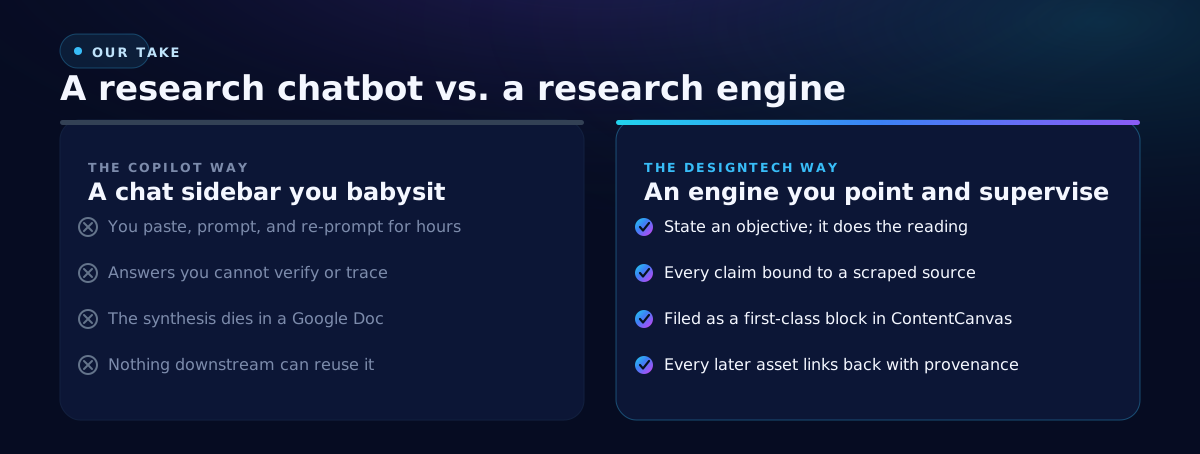
AI market research is supposed to fix this. Mostly it has not, because the tools bolt a chat sidebar onto the side of a doc and leave you to babysit it. You still paste, prompt, and re-prompt. You still get answers you cannot verify. And the output still dies as text no downstream asset can reuse.
We think research should be the front door to your entire content operation, not a throwaway artifact. Here is what that looks like when the research engine is wired into the same blocks your assets are built from.
The real problem: research that evaporates
Two things are broken about how most teams research.
The first is effort. Genuine market and competitor research is slow, skilled work, and it does not scale with a chatbot that hallucinates confidently and cites nothing. A summary you cannot trust is worse than no summary, because someone has to re-check every claim before they can build on it.
The second, and the deeper one, is that research is trapped the moment it is done. It lives as a file. A file is a sealed box: no other tool, no teammate, and no AI can reference the specific claim inside it later. So the same ground gets covered again and again, and the compounding asset a marketing team should be building, a living body of knowledge about its market, never compounds.
Our take: point an engine at an objective, then supervise
The copilot model of AI is the wrong shape for research. You cannot reach a transformed outcome by appending an assistant to an un-transformed product. The right model is to state an objective and let an engine do the reading while you supervise the result.
In DesignTech AI you ask the Studio to research something, in plain language, and it runs its Research the web capability. The input is an objective, phrased the way you would brief an analyst. "How are B2B SaaS teams using AI in 2026?" is a complete brief. From there the engine, not you, does the reading.
Research should not be a document you write. It should be an objective you set, and a source your whole team and your AI can build on for months.
Two principles make the output trustworthy rather than plausible:
- Grounded, not guessed. Every claim in the briefing is cited to a page the engine actually read. It is instructed never to invent facts, figures, names, or quotes, and to say where it could not find something rather than filling the gap.
- Filed, not dumped. The briefing is saved in your Gallery's Research tab with its sources, searchable and reusable, so every asset you build from it links back to the research that grounds it.
How it actually works
The mechanics are deliberately concrete:
- State the objective. One sentence. You can also name up to five company websites to research, and a reporting window ("the last 90 days").
- Choose where to look. The open web is the default. You can add LinkedIn, Crunchbase, Reddit and the news, each searched on its own, so a Reddit result is really from Reddit.
- Read and synthesize, grounded. The engine runs the searches, reads the pages behind them, and writes one briefing bound to what it read, with a register of its sources.
- File it as a source. The briefing lands in your Gallery as research, carrying its evidence. It is immediately available to anything you make next.
That last step is the one that changes the economics. Because the briefing is filed with the rest of your material and not stranded in a doc, the next thing you ask for, a messaging framework, a blog post, a campaign brief, can be grounded directly in it, with a traceable line back to the sources.
Why this is the front door to Plan
Research sits at the very front of the marketing workflow on purpose. It is one of the few things the platform does that produces brand-new source material rather than transforming content you already have. Everything downstream, the recommendations, the briefs, the finished assets, gets better when it is grounded in current, cited market reality instead of a model's stale training data. For a head-to-head read of up to five rivals, the Competitor analysis app runs the same research on each company and writes them up side by side.
Run it once and you have a briefing. Run it as a habit and you are building something a chatbot can never give you: a compounding, searchable, provenance-linked map of your market that every asset you ship is quietly standing on.
That is the difference between using AI to answer a question and using it to build an asset. Start with the objective. Let the engine read. Keep the block.
Next in the Plan series: let an engine recommend what to create from a source you already own, and pin the campaign in a brief and media plan that does the math for you.